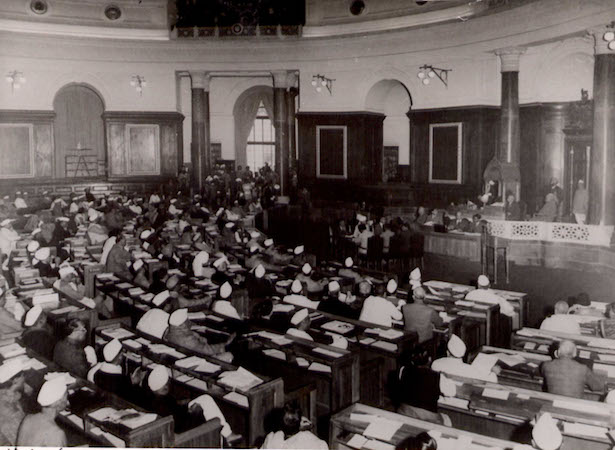
While Ambedkar and Congress drafted competing constitutional visions between 1928 and 1947, ordinary people and small organizations were sending petitions to the Constituent Assembly—hundreds of them. Three petitions from 1947-48 offer a glimpse of how some marginalized groups approached constitutional questions, though we should be careful about what we claim from them. These were petitions—often narrowly focused, addressing specific grievances—not comprehensive constitutional texts like Ambedkar’s proposals. But read alongside those earlier documents, they’re suggestive about how constitutional politics looked from the ground, and may reveal how the terms of debate had shifted by the Assembly’s final years.
The Hind Harijan Sangha petition from Kalimpong in May 1947 opens with a familiar problem. Local Harijans in Darjeeling district had been “totally ignored or left out of consideration” in representation, perhaps because there was no “well organised institution” when the Government of India Act 1935 allocated seats. By 1947, they had organized, but seats were already distributed. They were asking the Constituent Assembly President to nominate their representative to a single seat.
The petition makes a straightforward claim: separate representation is necessary because caste Hindu representatives cannot be trusted. “The Nepali caste Hindu representative if any in the Constituent Assembly is not expected to look after and guard their interest to the extent to which their existing conditions demand.” This echoed Ambedkar’s longstanding argument for separate electorates—that joint electorates allowed upper-caste voters to determine which Dalits got elected, favoring those willing to compromise.
What stands out is the petition’s attention to local specificity. The district population was about 360,000, nearly 200,000 of them Scheduled Castes and Harijans, mostly Nepali-speaking. Their position among Nepali caste Hindus “is nothing better than that in Nepal which still holds on to the most abominable type of hatred and orthodox conventions.” Conditions were worse, the petition claimed, than those facing Harijans “in Madras and other parts of India.” Geographically isolated, linguistically distinct from Bengali Harijans, facing orthodox Nepali Hinduism—the specificity matters.
This suggests an understanding that proximity to caste Hindus could guarantee subjugation—something like what Ambedkar argued when proposing separate settlements in 1944. But where Ambedkar’s documents laid out systematic solutions—criminalization, economic transformation, separate electorates—the Sangha could only ask for a favor: “I would therefore request you to be kind enough to let me know if you could make any provision for a ‘seat’.” Formal deference (“I beg to remain, respected Sir, Yours fraternity”) alternated with frank description of oppression.
The petition worked entirely within the system as constituted. It didn’t demand constitutional criminalization of the “hatred” it described, didn’t propose economic redistribution. Just one nominated seat. Whether this reflected genuine belief that representation alone would suffice, or simply what seemed possible to request by 1947, is hard to say from a single petition.
The All-India Lingayat Unity League petition from January 1947 makes a different claim: we are distinct, we deserve recognition. The petition asserts that Lingayats, numbering ten million, are “quite distinct from the four-fold Caste Hindus” yet have no representation in government or the Assembly “while all other minor communities like Christians, Sikhs, Parsis, Anglo-Indians, &c, are fully represented.”
The petition’s logic is simple: communities deserve representation proportional to population. This confronts caste not by attacking hierarchy but by refusing categorization. Lingayats claimed to be distinct from “four-fold Caste Hindus”—neither part of varna nor a separate religion. Were they Hindu or not? The petition does not resolve this, simply asserting distinctness and demanding recognition.
This reveals something about constitutional categories. Congress treated caste as internal Hindu variation. Ambedkar increasingly argued Dalits were not Hindus at all. The Lingayat League occupied uncertain ground—distinct enough to feel unrepresented, not distinct enough to warrant separate minority status.
The petition makes no economic demands, says nothing about land or employment. As framed here, the constitutional problem was categorical invisibility needing representational remedy. This was quite different from Ambedkar’s analysis, where getting Dalits into legislatures without redistributing land meant nothing. Whether this reflected actual Lingayat material conditions or just the terms of debate by 1947 remains unclear from this document alone.
In April 1948, D.V. Narasimha Rau, a headmaster in Andhra, announced he was renaming himself Franklin Ram Mahomed—combining Christian, Hindu, and Muslim names. His statement blamed Gandhi’s assassination on denominational divisions and proposed “total, merciless obliteration” of “all types of differentiations.”
The analysis was sweeping. Denominational divisions produce hatred, suspicion, distrust. Gandhi’s death proved the futility of promoting tolerance while maintaining separate denominations. The solution was radical universalism: peace required obliterating all communities and differentiations. Individuals should adopt names combining Hindu, Muslim, and Christian elements.
Caste gets confronted here through symbolic transformation. If categories enable exclusion, erase the categories. There’s a consistency to this, but it’s also profoundly ahistorical. Narasimha Rau could rename himself because he was an upper-caste headmaster with institutional position. For a Dalit or landless laborer, renaming accomplishes nothing. Material conditions—landlessness, economic dependence, boycott—persist regardless of what you call yourself.
What the petition reveals is a strain of thought that believed symbolic transformation could substitute for structural change. Gandhi opposed criminalizing untouchability, preferring appeals to conscience. This petition extends that logic: if names create division, rename yourself into unity. But as Ambedkar understood, division was material before it was symbolic.
What These Petitions Might Suggest
These three petitions show different ways people approached constitutional questions. The Hind Harijan Sangha grasped that caste Hindu representatives wouldn’t protect their interests, but could only petition for a nominated seat. The Lingayat Unity League understood that categorical invisibility meant exclusion, but sought recognition within existing frameworks. Franklin Ram Mahomed proposed symbolic erasure rather than material redistribution.
None engaged with caste as Ambedkar’s documents did. None demanded criminalization of boycott or state ownership of agriculture. This may tell us something about what seemed possible or appropriate to petition for by 1947-48. The Constituent Assembly was debating fundamental rights and minority safeguards, not land reform. Ambedkar’s radical economic demands had already been sidelined. Perhaps petitioners grasped that requesting seats and recognition was more likely to get response than demanding structural transformation.
Then again, these particular petitions may reflect only certain kinds of demands—those focused on representation rather than redistribution. Other petitions we haven’t examined might have made economic demands. We should be careful about generalizing from three documents.