
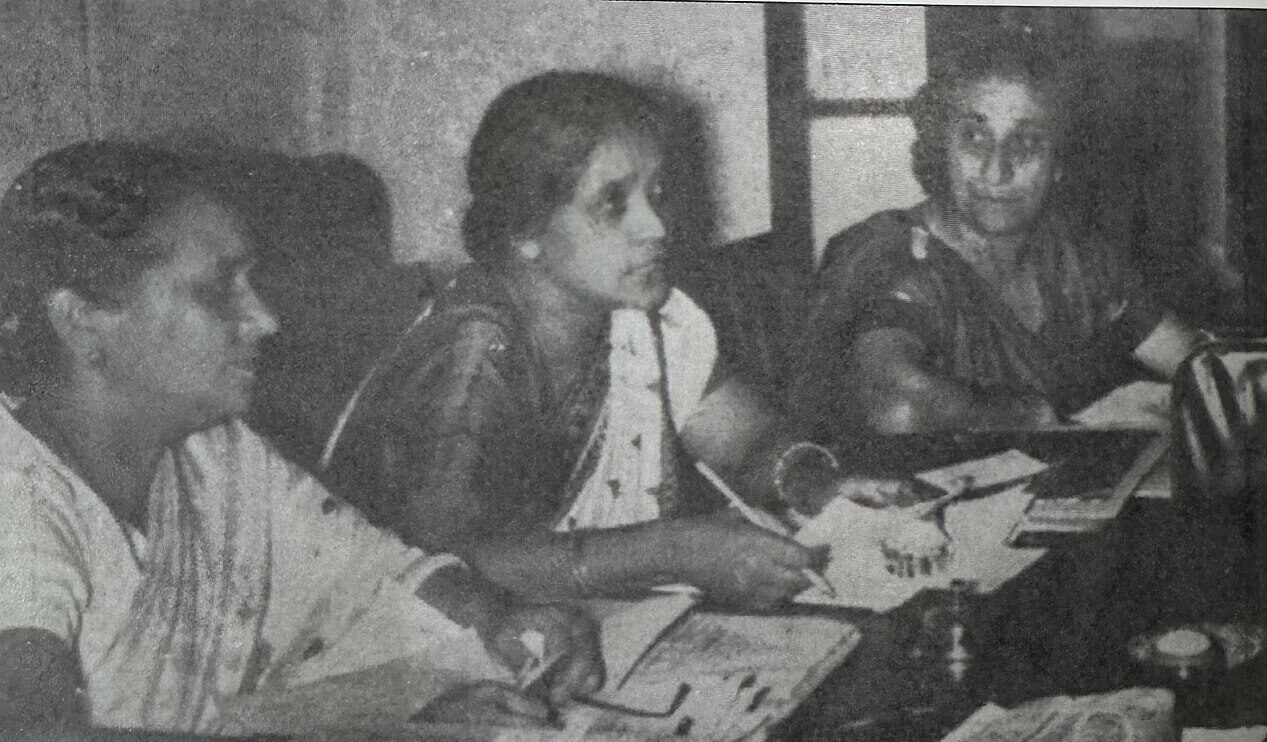
In May 1946, the All-India Women’s Conference submitted a document to the United Nations Sub-Commission on the Status of Women. Signed by Hansa Mehta and Lakshmi Menon, it was titled the Draft of Indian Woman’s Charter of Rights and Duties. India’s Constituent Assembly had just been constituted. The Constitution had not yet been written. The Charter was a bid to shape what it would contain.
A previous piece on this site traced how Indian women had been thinking constitutionally since at least 1917 — petitioning the Montague-Chelmsford Commission for the franchise, lobbying the Southborough Committee, securing resolutions from the Indian National Congress and the Muslim League, and eventually contributing to the Commonwealth of India Bill 1925, which included a fundamental right against sex discrimination. The Charter of 1946 is the culmination of that tradition: what thirty years of constitutional advocacy by Indian women’s organizations looked like when gathered into a single document.
The AIWC’s foreword is candid about what the Charter is. The organization had existed for eighteen years, passing resolutions aimed at improving the status of Indian women. The Charter brought those resolutions together — to give a “clear picture of the ideals for which we stand,” to form a basis for future legislation, and to lay out the demands that should govern any constitutional framework for the new nation. The demands, the foreword notes, are “by no means final, nor do they claim to be exhaustive.” You can hear in that phrasing an organization that had learned, through decades of petitioning British commissions only to be dismissed, how to hold its ground without inviting dismissal on procedural grounds.
Rights and Duties
The Charter’s preamble opens with a universalist claim: “freedom and equality are essential to human development and woman is as much a human being as man and, therefore, entitled to share them with him.” Then comes a harder-edged argument: the well-being of society depends on the extent to which both men and women develop their full personalities, and the position of women in India is “in large measure responsible for the backwardness of the country.” This is a political calculation as much as a moral one — women’s emancipation cast as a national necessity, not a favour.
The Charter also insists on duties in a way that most rights documents do not. The foreword states plainly that Indian women are “entirely oblivious of their duties as citizens.” The final section calls on women to take up essential services, fight social evils including child marriage, purdah, polygamy, caste, and untouchability, educate themselves for good citizenship, and strive for world peace. This is a demanding vision of civic life — rights understood not as an endpoint but as the foundation for a more active form of participation.
The Scope of the Demands
The Charter ranges across twelve substantive areas. On education, the demands are extensive: free and compulsory basic education for every boy and girl between seven and fourteen; co-education at all stages; scholarships for girls; compensation for poor parents reluctant to send daughters to school; hostels to make attendance possible; residential schools for adult women in rural areas. Underlying all of it is the assertion that “there shall be no basic difference between the education of man and woman as their duties as citizens are the same” — a direct rejection of the prevailing idea that girls needed a different, domestically oriented curriculum.
On work, the Charter demands the right to employment regardless of sex, equal pay for equal work, and no discrimination in public services. On property, it calls for the removal of Hindu women’s inheritance disqualifications and equal shares for daughters and sons in parental property.
The marriage law section is the most legally precise in the document. It calls for mandatory consent of both parties, minimum ages of sixteen for girls and twenty-one for boys, no restriction on inter-caste or inter-community marriage, divorce on grounds including cruelty, desertion, incurable disease, and impotency, proceedings in camera before a specialized matrimonial court, alimony for the divorced wife, and abolition of the dowry system by law.
The Home-Maker
The section that most exceeds its time is the one on the home-maker. It starts from a recognition that the woman who works in the home performs labor of genuine economic value that the law refuses to see. The demands follow from that: the home-maker shall have a right to a share of her husband’s income, to be used as she sees fit; the husband shall have no right to dispose of his entire income without her consent; any government social insurance scheme shall include the home-maker, with contributions deducted from the husband’s income if the wife has none of her own.
None of this found its way into the Constitution. The claim that domestic labor entitles a woman to a share of household income, that unpaid care work should be covered by social insurance — these were not settled questions in 1946 and they are not settled now. The Charter raised them in plain legal language at a moment when almost no one else was.
On moral standards, the document is equally direct. The traffic in women and children flourishes, it notes, because “the men who are partners in the sin escape while the women suffer.” The demand: “there should be an equal moral standard for men and women.” Four words that cut to the center of a double standard written into law as much as custom.
The Constituent Assembly
The Charter connects directly to the formal constitution-making process. Hansa Mehta and Lakshmi Menon, who signed it, were both members of the Constituent Assembly. These were not women petitioning from outside — they were sitting inside the room where the Constitution was being written, carrying with them the accumulated demands of three decades of women’s constitutional thought.
The previous piece on this site ended by asking whether Indian women had a constitutional vision before the Constituent Assembly convened, and answering that they did. The Charter shows what that vision looked like in full. It was detailed, legally specific, and in several respects more ambitious than the Constitution that emerged. T