“The irony of the universal ideal of citizenship,” says Sukanya Banerjee (p. 193), “…is that it chooses the highly particularized category of the nation-state to announce its universality.”
As per the traditional constitutional view, the coming of universal citizenship to India coincided with the country’s crystallisation as a republic.[1] The scholars who advance this view treat the adoption of the Constitution of India, 1950 [‘the Constitution’] as a decisive moment that converted the people of India from ‘subjects’ to ‘citizens’. As per this view, the Constitution’s framers adopted the ideal of universal ‘legal citizenship’, which was marked by a commitment to equal and universal political membership irrespective of social identity.
Against this background, it has been argued that in the last decade, the Indian political discourse relating to citizenship has been overtaken by a ‘politics of belonging’, where particularities like religion, language, and even ‘loyalty’ become criteria for Indian citizenship. It has been argued that this political discourse departs significantly from the notion of citizenship adopted at the time of the Constitution’s enactment.
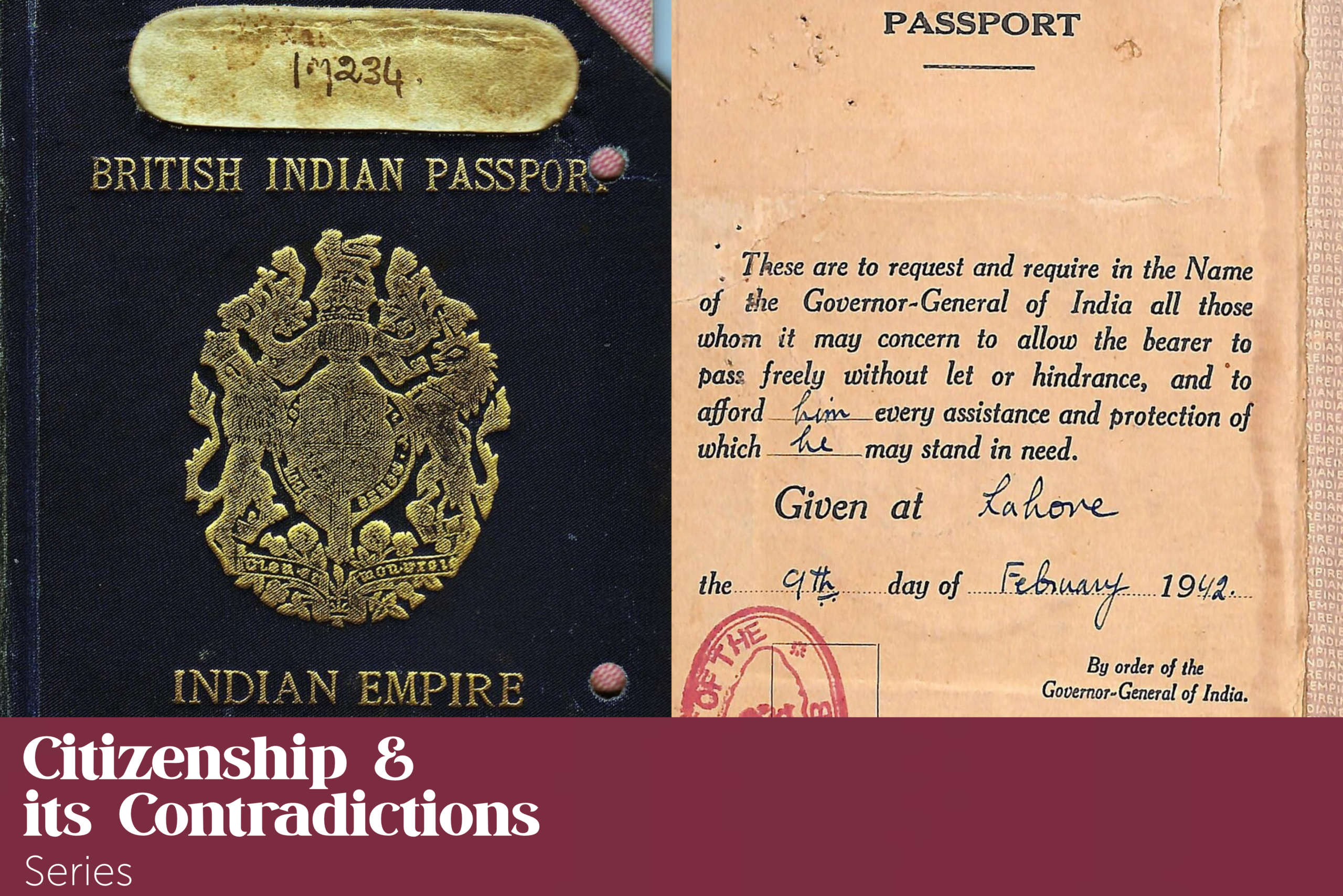
In this series of posts, I demonstrate that this politics of belonging does not deviate conceptually from the political discourse relating to citizenship in earlier periods of India’s history. Rather, the contemporary politics of belonging merely manifests the contradictions inherent within the ‘universal’ concept of citizenship to a greater degree. These contradictions have existed in politics in the Indian subcontinent since Indian ‘subjects’ of the British colonial empire started making claims of an imperial citizenship. In the first post, I focus on the political assertions of Indian colonial subjects who migrated to different parts of the Empire. For many, the promises of instruments like the Queen’s Proclamation became a rallying cry to agitate for treatment on par with other British subjects. As Banerjee highlights (p. 191), while the Indian subjects’ claims to an imperial citizenship were doomed to failure, they generated a political vocabulary of citizenship and gave prominence to the assertion of citizenship as a political category.
In the second post, I will demonstrate the parallels between these colonial assertions of imperial citizenship, and the constitutional and political discourses relating to citizenship in post-colonial India.
Tension within Citizenship
Hannah Arendt argues that despite the universal pretensions of the ‘rights of man’, their protection ultimately depended on belonging to a state – a status which was very easily lost. She discusses how national boundaries were drawn across ethnic lines in post-World War I Europe. This rendered 30% of the European population as minorities and stateless individuals, who had no protection other than Minority Treaties, which all Governments (except Czechoslovakia) had signed under protest and never recognised as law (p. 269). “The Rights of Man,” she says “supposedly inalienable, proved to be unenforceable – even in countries whose constitutions were based upon them – whenever people appeared who were no longer citizens of any sovereign state.” (p. 293) This ‘loss of home’ was accompanied by the impossibility of finding a new one. Suddenly, there was no place on earth where migrants could go without the severest restrictions, no country where they would be assimilated (p. 293).
The emergence of nation-states thus formed the (exclusionary) base through which ‘universal’ citizenship was recognised. In the absence of such a nation-state, the recognition of universal citizenship in the British Empire stood on unsteady grounds.
Subjects claiming Citizenship
By 1914, the British Parliament had enacted the British Nationality and Status of Aliens Act. This statute codified the common status of all subjects of the Crown throughout the Empire. Nevertheless, migrants had to contend with the authority of dominion legislatures to assert such equal status. Such migrants often relied on promises like the Queen’s Proclamation as a constitutional source of an imperial citizenship, which entailed certain rights that were allegedly violated by the respective legislative measures. For instance, the petition protesting the deportation of Mool Chand, an Indian residing in Australia, stated that he:
“has been a quiet inoffensive law-abiding citizen, and can in no sense be deemed to be a danger to the State of Western Australia … His rights as a British subject were secured to him by the Mutiny Proclamation of 1859 [sic], and by the Proclamation of His Majesty at the Delhi Durbar in 1901 [sic], and it is not within the competency of the Australian legislature or executive to override these proclamations … the Magna Charta [sic] of the rights and privileges of the people of India.”[2]
However, such claims of Indians having equal rights within the Empire rested on uneasy foundations. This was because promises like Queen Proclamation was not intended to bestow citizenship in the way that the immigrants contended. This is highlighted by the comments of Richard Jebb, an imperial journalist, in response a plea by an Indian commentator Srinivas Sastri for equal rights within the Empire. Jebb states that it was erroneous to say that “there exists such a thing as a common ‘citizenship’ of the British Empire.” If citizenship meant a relation between the individual and the state whereby the ‘citizen’ could “influence the policy of the State,” then, Jebb states that there can be no citizenship of the empire, for the “British Empire is not a State.… What has existed, does exist, and can continue to exist,” he conceded, is “a status common to all the peoples of the British Empire as ‘subjects’ of the Britannic Crown.”[3]
Jebb’s reasoning for denying the imperial status claimed by Indians the title of ‘citizenship’ was that the British Empire was not a state. The lack of statehood, as Arendt notes, leads to a lack of equalisation of the differences necessary for racialised subjects to have rights. Without such membership, they “…belong to the human race in much the same way as animals belong to a specific animal species.”
Particularised Belonging and the Appropriation of Universalism
Banerjee notes (p. 23) that the Queen’s Proclamation was not prompted by a universalist imperative of delinking rights with social status that animated the Virginia Declaration of Rights in 1776, or the Declaration of the Rights of Man and Citizen in France in 1789. As per Banerjee, “the proclamation was more conciliatory in objective, hoping to effect an equable transition of power from the East India Company to the Crown. That it went on to provide the cornerstone for Indian claims to a citizenship based on universalist notions of equality is indeed catachrestic.” Therefore, the use of the Proclamation as a universalist charter was what Butler calls a ‘perverse reiteration’ that produced ‘unconventional formulations of universality’ that mobilised a new set of demands (p. 40).
Regardless of whether the quest for imperial citizenship was ‘doomed to fail’, a study of the quest enables us to ask what the ‘success’ of citizenship claims might mean (p. 195). In this context, it is interesting to note the ways in which Indian subjects sought to assert this citizenship.
The chief contrast relevant in this context is the difference between assertion of citizenship as particularised belonging to the Empire and the rational-universal framing of citizenship. While the impact of the American and French revolutions saw the framing of citizenship in the latter terms, political membership in Britain still relied on allegiance of the subject to the King, despite the inroads made by parliamentary democracy, thus producing ‘hybrid citizenship’.
The tension within this hybrid citizenship comes through in the pleas and petitions of racialised colonial subjects. While cases like that of Mool Chand and the assertions made by Srinivas Sastri reflected the rational-universalist idea, in other cases we see claims of citizenship made through assertions of belonging to a political community or through familial loyalty to political power. A case in point would be the statement made by the Indian delegate to the Imperial War Conference of 1917, Satyendra Sinha:
“India has in a peculiar degree a sense of loyalty to the person and throne of the monarch in Britain, and it would, therefore, give the greatest satisfaction to my countrymen that this Conference should unequivocally express its declaration that the monarchical form of government is best suited to the requirements of the Empire.”[4]
A similar dynamic is evident in Gandhi’s insistence on the Indian right to franchise in Natal by emphasising Indian allegiance to the Queen. As Banerjee writes (p. 27):
“Gandhi’s statement, rather, can also be read as illustrating the paradox of a discourse of citizenship that can argue for formal equality only on the basis of allegiance to the monarch, imbricating a post-Enlightenment discourse of liberal citizenship with a discrepant familial loyalty that renders rational framings of citizenship hardly self-evident.”
Therefore, the tension between the particularist mode of assertion of citizenship and its universal nature is laid bare in the colonial politics of imperial citizenship. Particularised belonging as a mode of assertion was deployed by Indians to demand inclusion within a supposedly universal political community. However, the risk with arguments of belonging is that their significance in politics is a function of who defines it, what form it takes, and what consequences are attached to it. As we shall see in the next post, the discourse around citizenship at the time of the framing of the Constitution and the years following it utilised arguments of particularised belonging to very different ends.
[1] See Gautam Bhatia, The Transformative Constitution: A Radical Biography in Nine Acts (HarperCollins 2019); Anupama Roy, ‘Sifting, selecting, relocating citizenship at the commencement of the Republic’ (2009) Centre for Women’s Development Studies Occasional Paper 54.
[2] Petition on behalf of Moolchand Shivcharan Dass (30 October 1905) in National Archives of India, ‘Alleged Unlawful Deportation from Australia of a Native of India’ 90 cited in Margaret Allen, ‘‘I Am a British Subject’: Indians in Australia Claiming Their Rights, 1880–1940’ (2018) 15 History Australia 499.
[3] Richard Jebb, ‘Letter to the Editor’ Morning Post (29 June 1921) cited in Sukanya Banerjee, Becoming Imperial Citizens: Indians in the Late-Victorian Empire (Duke University Press 2010) 25.
[4] As cited in Banerjee (n 3) 27.