
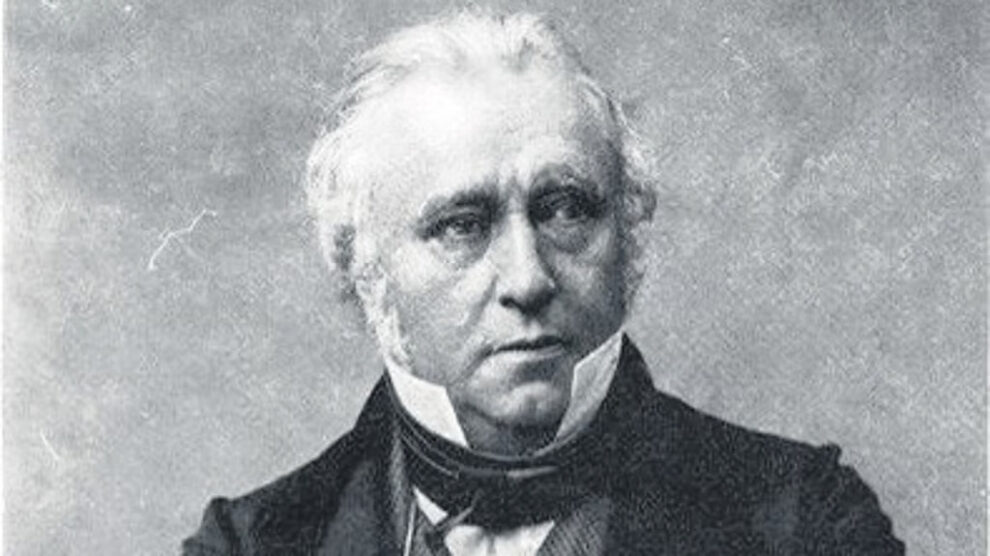
When contemporary political leaders invoke the “Macaulay mindset,” they reference Thomas Babington Macaulay, whose 1835 Minute on Education reshaped Indian society. This piece examines his educational reforms through the divergent experiences of marginalized communities, traces how India’s Constituent Assembly grappled with his legacy, and situates these historical debates within contemporary decolonization efforts
The Minute
Macaulay’s Minute on Education, presented in February 1835, addressed how British India should allocate funds for “the revival and promotion of literature and the encouragement of the learned natives of India.” His answer advocated decisively for English-medium education over traditional Sanskrit and Arabic learning. The Minute declared that “a single shelf of a good European library was worth the whole native literature of India and Arabia,” characterizing Sanskrit and Arabic as repositories of “false History, false astronomy, false medicine.” Macaulay proposed creating “a class of persons, Indian in blood and colour, but English in taste, in opinions, in morals, and in intellect”—intermediaries who would serve as “interpreters between us and the millions whom we govern.” This policy systematically shifted government patronage from traditional pathshalas and madrassas toward English education institutions.
Mother English
For caste-marginalized communities, Western education opened doors to knowledge systems that traditional hierarchies had barred. Savitribai Phule captured this perspective in her 1854 poem “Mother English”:
Mother English and the English language
Resolve to uplift Shudras;
Mother English, not the Mughals,
Not the Peshwai, that foolhardy reign.Mother English grants real knowledge
And with care offers Shudras a life.
Mother English feeds mother’s milk (panhā) to Shudras
And nurtures Shudras like a Grandmother (ajī).Mother English breaks brutality (pasutva)
And offers humanity (manuṣyatva) to the Shudra people.
Phule, who worked to establish schools for girls and lower-caste communities, viewed English as a liberating force, contrasting it with the Peshwa regime that enforced caste restrictions. For marginalized communities who faced severe punishment for accessing Sanskrit texts, British education created unprecedented possibilities. Yet for communities invested in Sanskrit and Persian learning, English education represented displacement. Traditional scholars lost patronage as government support shifted to colonial institutions. What appeared as emancipation to some was experienced as cultural erasure by others—a divergence that would echo through subsequent debates.
Ambedkar’s Engagement With Macaulay
Macaulay’s influence extended beyond education. His drafting of the Indian Penal Code, enacted in 1860, established a comprehensive criminal law framework. As Ambedkar noted, the British “abrogated the Hindu Criminal Law and made the Muslim Criminal Law the law of the State” under Muslim rule, but then displaced it with “Macaulay’s Penal Code.” This legal framework remained in use for over 160 years. Even recent reforms that renamed it—the Bharatiya Nyaya Sanhita and related codes—retain the foundation of Macaulay’s original codification.
In Pakistan or Partition, Ambedkar documented Muslim political decline: “every change, executive, administrative, or legal, introduced by the British, has inflicted a series of blows upon the Muslim Community.” The displacement of Muslim Criminal Law by Macaulay’s Penal Code, the replacement of Persian with English, and the abolition of Qazi courts each diminished Muslim institutional standing. Ambedkar recognized Macaulay’s reforms as transformative historical forces.
For his own anti-caste struggle, Ambedkar strategically embraced these same systems. He wielded English education and Western legal frameworks against caste discrimination. In the Constituent Assembly debates, he defended English on technical grounds: “Law-making and law-interpretation require an amount of precision; they require a number of expressions and words which have acquired a certain definite meaning; and until we reach that stage in regard to the Hindi language… English will last in the form of bills and Laws much longer than fifteen years.”
The Constituent Assembly Debates
Ambedkar’s defense of English in the Constituent Assembly exemplified this pragmatism and sparked broader debates about language, national identity, and governance. In September 1949, the Assembly confronted whether independent India should continue using the colonizer’s language. Ambedkar argued on technical grounds: “Law-making and law-interpretation require an amount of precision; they require a number of expressions and words which have acquired a certain definite meaning; and until we reach that stage in regard to the Hindi language… English will last in the form of bills and Laws much longer than fifteen years.” R.V. Dhulekar opposed this view: “What will the host of Lord Macaulay say? He will certainly laugh at us and say, ‘Old Johnnie Walker is still going strong.'” He viewed even a fifteen-year transition as inadequate surrender to colonial mindsets.
Gopalaswami Ayyangar emphasized practical challenges: “the languages which we can recognize for Union purposes… are not sufficiently developed, are not sufficiently precise” for legal work. Jawaharlal Nehru acknowledged English came “because it was the conqueror’s language” while noting its role in opening “doors and windows of foreign thought, foreign science.” He cautioned against imposing Hindi on resistant populations. South India representatives expressed concerns about linguistic marginalization. Frank Anthony observed that “India’s acceptance of leadership in the international field is due largely… to the capacity of our representatives abroad to hold their own… in speaking English.”
N.V. Gadgil recalled that Macaulay “wrote that it would be a glorious day for Britishers when Indian people would ask them to vacate.” Raghu Vira cited Macaulay’s prediction about creating Indians “English in everything except their skin.”
Macaulay’s name appeared throughout these debates. The final constitutional compromise established Hindi in Devanagari script as official language while continuing English for fifteen years, with provisions for extension. This reflected practical governance needs, concerns about marginalizing non-Hindi speakers, and nationalist aspirations. The transition period was later extended indefinitely.
The Decolonization Debate
These historical complexities have resurfaced in contemporary decolonization discourse. Political leaders invoke the “Macaulay mindset” to suggest that colonial-era attitudes still shape Indian institutions, education, and elite culture—that independence should have brought more thorough transformation than it did. Yet this framing risks flattening a contested history. The Constituent Assembly debated English continuation extensively, weighing linguistic diversity, administrative pragmatism, international engagement, and cultural nationalism. The Constitution’s provisional retention of English alongside Hindi reflected deliberate compromise, not colonial baggage.
More fundamentally, Macaulay’s legacy resists singular interpretation. Phule’s celebration of English as emancipatory and concerns about Sanskrit displacement coexisted as legitimate responses to the same historical moment. Ambedkar could simultaneously document how British reforms destabilized law and society in India while deploying those same reforms against caste oppression.
Contemporary decolonization efforts must reckon with this complexity. The question isn’t whether colonial institutions caused harm—they demonstrably did. Rather, it’s whether we can acknowledge that some communities found resources for resistance within those same institutions, that marginalized groups sometimes had different stakes in colonial systems than dominant ones, and that dismantling colonial legacies requires understanding whose emancipation and whose erasure they enabled.