
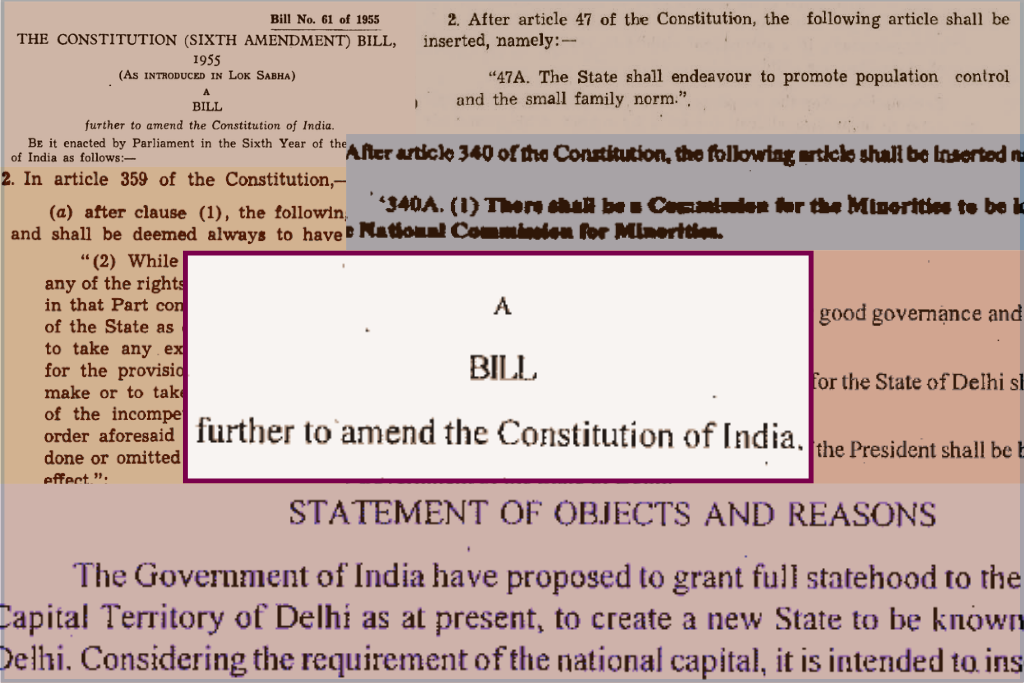
We began expanding the constitutionofindia.net archive to include a new category of material, constitutional amendments, with blog posts analysing their range and scope. First, we explored whether constitutional amendments are more likely when a single party has a threshold majority in the Lok Sabha, finding that this was not as likely as is commonly assumed. Second, we developed a simple framework to assess the significance of amendments made to the Indian Constitution till date on three simple parameters, finding that while some amendments like the 42nd Amendment will retain salience irrespective of the framework chosen, most amendments are only significant along a single axis.
However, both posts analysed successful amendments. While successful amendments are a major part of constitutional evolution in independent India, several proposed amendments failed for various reasons. These ‘failed’ proposals provide us with insight into alternative pathways and constitutional imaginations that may yet stage a comeback. Like historical constitutions developed before or in parallel with the drafting of the Constitution of India, failed amendment proposals are an essential interpretive tool for lawyers, judges and laypersons alike.
Why do failed amendments matter?
Jill Lepore notes that while the United States Constitution with its 27 amendments has one of the lowest amendment rates in the world, ‘some twelve thousand amendments have been formally introduced on the floor of Congress’.[i] She attributes the gap between the number of proposed and enacted amendments to the difficulty of amending the federal constitution, observing that it ‘leaves Americans to what political scientists have called the “tyranny of the majority”’.[ii] Yet, Sanford Levinson argues that a mere ‘reference to the numbered textual additions’ to the constitution is insufficient to fully understand constitutional evolution.[iii]
Recent writing has highlighted how the ‘memory and authority’ of failed constitutional amendments may influence judicial interpretation. Using the example of the failed Equal Rights Amendment in the American context, for instance, this paper argues that failed constitutional amendments may influence both judicial interpretation of existing constitutional provisions and courts’ use of history in constitutional interpretation generally.
‘Failed’ Amendments in India
As the graph above shows, 49 constitutional amendments proposals have been introduced in the Indian Parliament but failed (that is, withdrawn, lapsed, defeated or remain pending in Parliament) till date.[iv] As the graph’s uneven rise and fall suggests, there have been some periods in which no such proposals were introduced (for instance, 1956-62, 1971-77, 1980-87 and 2014-18) as well as a few periods of intense activity. The highest number of failed amendments in a single year, eight, were proposed in 1990. The two decades following this peak were relatively active, with the 1991-2010 period seeing as many as 19 failed amendment proposals.
In our next posts in this series, we develop two distinct categories to analyse ‘failed’ amendments to the Indian Constitution and sketch a draft framework to better understand these constitutional proposals.
First, we categorize failed amendments by the procedural hurdles they confronted: that is, whether they were withdrawn by the member introducing them, lapsed due to dissolution of the House, defeated through voting; or are still pending in Parliament.
Secondly, we distinguish amendment proposals by their legislative persistence: bills that were introduced only once, bills introduced more than once, and those that failed initially but were ultimately enacted into law albeit through a different bill introduced later in Parliament. This mode of analysis allows us to examine the many lives of a constitutional idea that through iteration may finally succeed as a constitutional amendment.
We invite readers to propose other analytical frameworks and amendments for closer study in the weeks to come.
[Assisted by Niharika Mukherjee and Ishanika Sharma.]
[i] See Jill Lepore, We the People (John Murray Press 2025) 14.
[ii] Ibid 16.
[iii] See Sanford Levinson, Responding to Imperfection – The Theory and Practice of Constitutional Amendment (Princeton University Press 1995) 7.
[iv] A note on method: We have used the Lok Sabha and Rajya Sabha websites’ repositories of bills introduced in the House to compile this list, excluding amendments to the Scheduled Castes and Scheduled Tribes Orders and Private Members’ Bills. Private members bills are rarely passed, yet provide an alternative political imagination of possible pathways for constitutional evolution.
More blog posts
Assessing Constitutional Amendments: Text, Impact and Judicial Review
28 August 2026 • By Sudhir Krishnaswamy
An elementary framework to assess the significance of constitutional amendments in India - by scale of textual alteration, structural impact on institutional design, and judicial pronouncements of unconstitutionality.

Constitutional Amendments and India’s Political History
31 July 2026 • By Sudhir Krishnaswamy
A brief historical and analytical overview of constitutional amendments in India.