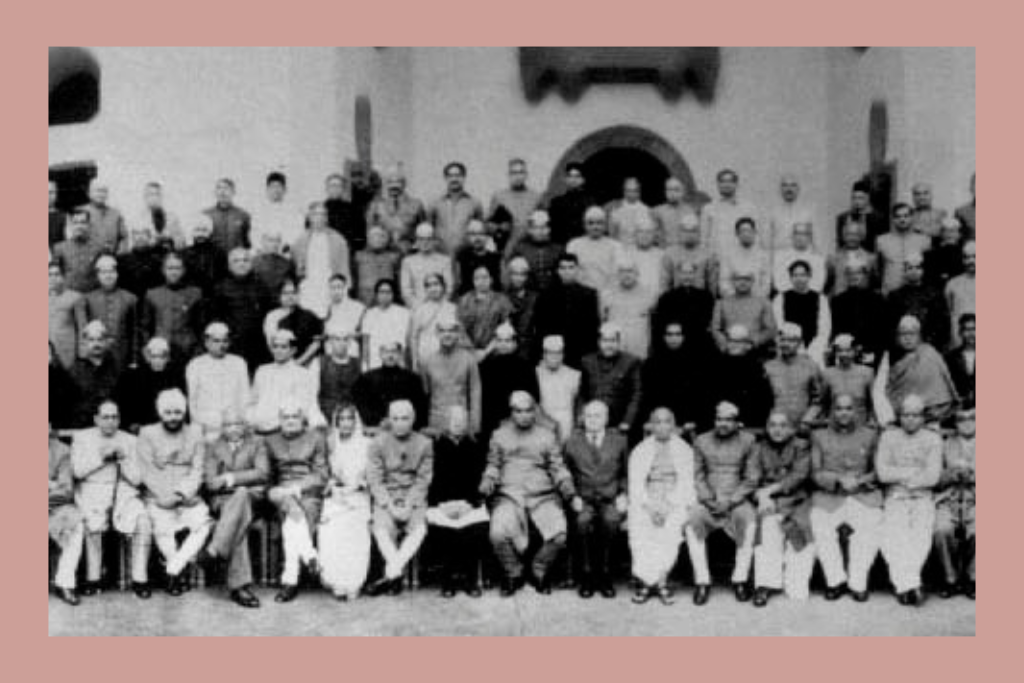
On 26th November 1949, the Constituent Assembly passed a motion to adopt the Constitution of India. Only a month earlier, however, its members had deliberately decided that most of its provisions must come into force two months later, on 26th January 1950. This was to commemorate the latter date, being that of the Purna Swaraj Declaration of 1930, in the memory of independent India, instead of the former, which had held no special significance in the history of the freedom struggle.
Debating Dates
In July 1947, the President of the Constituent Assembly had ambitiously hoped that it would finish its work by October of that year. The urgency stemmed from its dual function as both a body to draft a constitution for the country as well as its federal legislative body. Even so, the Assembly – perhaps acknowledging the importance of full deliberation – set no fixed deadline. When draft Article 314 (now Article 394 of the Constitution) was introduced on 17 October 1949 to indicate the date on which the Constitution would come into force, therefore, the date in the provision was left blank.
TT Krishnamachari from Madras proposed an amendment bringing eight articles into force ‘at once’, that is, on adoption of the Constitution, and the rest on 26 January 1950. The eight articles he proposed to have enforced immediately related to citizenship, definitions of terms used in the Constitution, and transitory provisions related to the election of the provisional Parliament and provisional President. Apart from HV Kamath’s acknowledgement that it had ‘a sanctity of its own in our national calendar,’ the date itself drew little comment. Instead, members debated the enforcement date of specific provisions.
For one, K Santhanam from Madras argued that the Preamble and Article 1 must also come into force at the time of adoption, for the ‘object of the Constitution and the name of the country must be there before any part of the Constitution can be brought into force’. To this, Alladi Krishnaswami Iyengar asserted that despite its importance, there was no reason for the Preamble to be brought into force before the whole Constitution. He also opposed immediate enforcement of Article 1, declaring India to be a Union of States, for adoption alone did not complete this transition. He observed:
“Secondly, I do not think we can bring into force the article that India shall be a Union because India does not immediately become a Union of States as it is understood throughout the Constitution. A Union must be understood with the entire constitutional mechanism that has been created under the Constitution which we are passing. We cannot conceive of a body or soul without limbs. If the limbs do not begin to operate how can a Union come into existence.”
For another, Biswanath Das from Orissa objected to including draft Article 311 (Article 379 of the Constitution) among the articles to come into force immediately. It stated that Constituent Assembly members who were elected to State legislatures before the commencement of the Constitution would lose their Assembly seats unless they resigned from the State legislature. Since ‘commencement of the Constitution’ had been understood to mean 26th January 1950, another member asked why the rule should come into force earlier. TT Krishnamachari explained that this was to allow the President to prepare for elections to fill positions in the Constituent Assembly/provisional Parliament as soon as they would fall vacant on 26 January 1950.
While neither of these amendments was adopted, the debate on this provision underscores how 26th January overshadowed the date of adoption in terms of significance – both legally and politically. The latter date was clearly seen as significant: HV Kamath from the Central Provinces, for instance, suggested a midnight ceremony on 25th/26th January 1950 similar to the Assembly’s observance of 15th August 1947, and Purnima Banerji from the United Provinces later even suggested including a reference to ‘Purna Swaraj’ in the Preamble.
Post-Independence Commemoration
It is interesting, in this backdrop, that three decades after Independence, in 1979, the Supreme Court Bar Association under the leadership of Dr LM Singhvi began to observe ‘Law Day’ on 26th November. It was seen as an occasion to reinforce commitment to strengthening judicial independence, maintain and augment faith in the legal and judicial system, and review the state of law and justice administration in the country.
The post-Independence revival of 26th November as a date of national importance received fresh impetus in 2015, when the Indian Government notified its decision to celebrate 26th November every year as ‘Constitution Day’ to ‘promote constitutional values among citizens’.[i] The notification framed this also as a way of honouring the Chairman of the Constituent Assembly’s Drafting Committee, Dr BR Ambedkar, in the year of his 125th birth anniversary. Public institutions have marked this day in the years since, including by organizing collective readings of the Preamble, student competitions related to constitutional history and Dr Ambedkar’s legacy and awareness campaigns on constitutional values.
Commemoration and Endurance
In their study of what makes a constitution endure, Ginsburg, Melton and Elkins write, ‘written constitutions are central institutions in the political order and powerful symbols of statehood,’ yet ‘in many times and places, constitutions are remarkably ephemeral’. They observe, too, that ‘establishing an enduring constitutional scheme appears to be quite difficult, particularly in new democracies outside of Western Europe and North America’.
In this light, perhaps the ‘collective remembering’ fostered by observances like ‘Constitution Day’ reinforces the value of constitutional endurance in India. It should also prompt reflection, both on the events and debates that have and continue to shape India’s constitutional history and of one’s own national identity as a participant in it.
Assisted by Vrinda Pradeep.
[i] Ministry of Social Justice and Empowerment, NOTIFICATION F. No. 19022/11/2015-VI (E) (19 November 2015).
More blog posts
Assessing Constitutional Amendments: Text, Impact and Judicial Review
28 August 2026 • By Sudhir Krishnaswamy
An elementary framework to assess the significance of constitutional amendments in India - by scale of textual alteration, structural impact on institutional design, and judicial pronouncements of unconstitutionality.
Failed Amendments to the Indian Constitution (Part 1): An Overview
23 October 2026 • By Sudhir Krishnaswamy
Beginning an analysis of ‘failed’ amendments to the Indian Constitution.