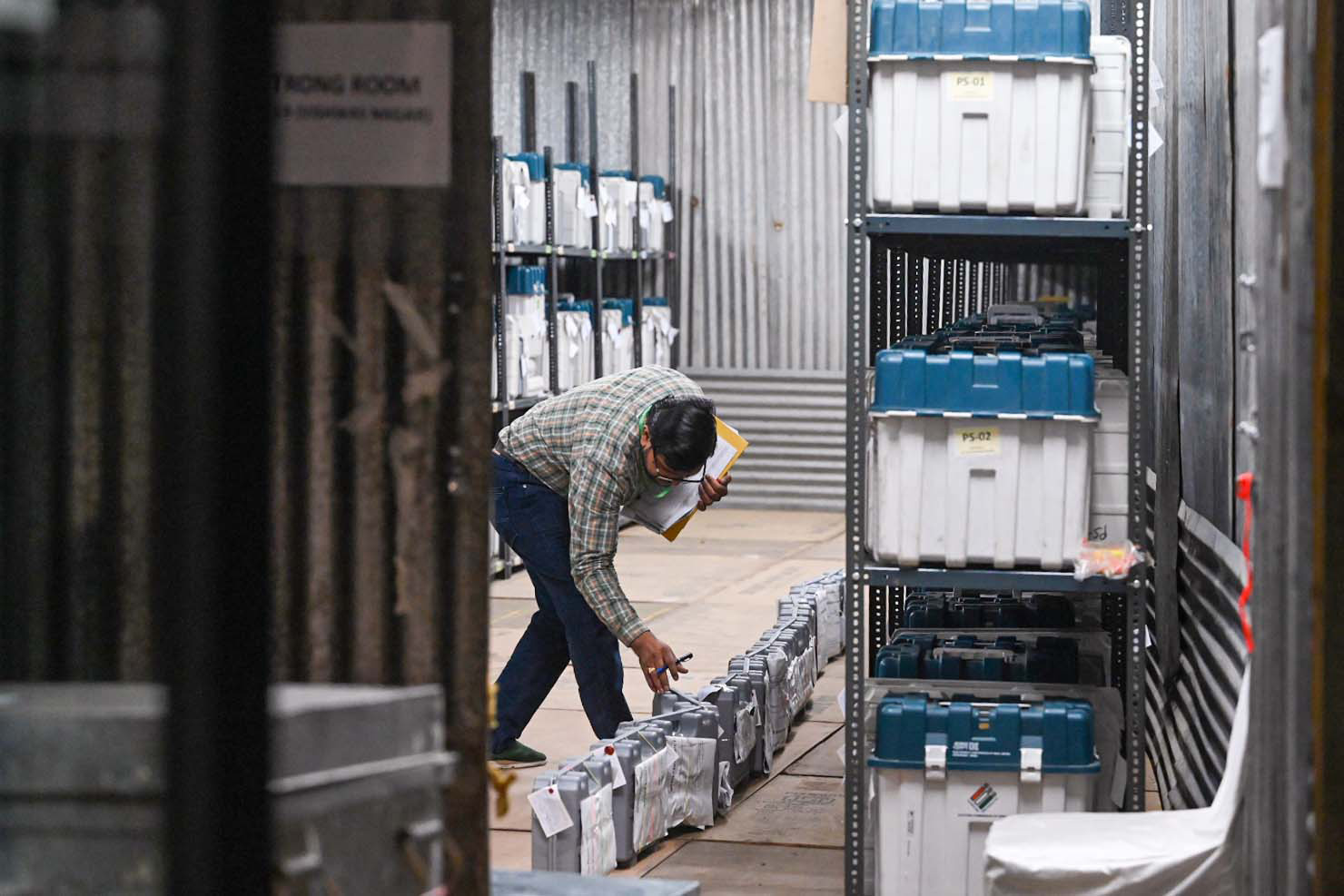
A Joint Parliamentary Committee (JPC) is examining the Constitution (129th Amendment) Bill, 2024 providing for simultaneous elections (commonly referred to as a proposal for ‘One Nation One Election’) to the Lok Sabha and State Legislative Assemblies. This Bill seeks to insert a new Article 82A (Simultaneous elections to the House of the People and all Legislative Assemblies) in Part V, Chapter II of the Constitution. It also proposes to make related amendments to Articles 83 (Duration of Houses of Parliament) and 172 (Duration of State Legislatures), as well as to Article 327 (Power of Parliament to make provision with respect to elections to Legislatures) to empower Parliament to make laws on matters in relation to simultaneous elections from time to time.
This Bill, along with the Union Territories Laws (Amendment) Bill, 2024 which provides for similar changes to elections in Union Territories, was introduced in the Lok Sabha in December 2024. It was subsequently referred to a JPC chaired by a Member of Parliament from the ruling party, which has been holding consultations with stakeholders across the country on the issue.
Among other material, the JPC has considered the report submitted in March 2024 by a High-Powered Committee chaired by former President Ram Nath Kovind, which recommended simultaneous elections in the country. Its reasons for this included curbing of expenditure and duplicated effort by the government machinery, reducing disruption in administration, addressing ‘policy paralysis’ due to frequent imposition of the Model Code of Conduct ahead of elections, and avoiding ‘voters’ fatigue’ due to frequent elections and enhancing voter turnout. The report also concluded that holding of elections once every five years would result in mitigation of social disharmony and conflict, often observed during elections.
The report observed that early after Independence, simultaneous elections were held across Parliament and the State Legislative Assemblies till the fourth general elections of 1967. Specifically, it noted that ‘conscious efforts’ were made by the Central Government, State Governments and political parties – ‘on persuasion of the Election Commission of India’ – to prematurely dissolve State Legislative Assemblies in the seven states of Bihar, Bombay, Madras, Mysore, Punjab, Uttar Pradesh and West Bengal, so that simultaneous elections could be held in 1957. To contextualise this observation, it is useful to examine the Constitution – its provisions and framing history – on the question of whether elections should be simultaneous.
Simultaneous Elections in the Constitution and Constituent Assembly
At the outset, the Constitution does not provide guidance on whether elections should be simultaneous, and Constituent Assembly Debates are also not determinative of the question. While the Assembly did debate Articles 83 and 172 on the duration of Parliament and State legislatures on 18 May 1949 and 2 June 1849 respectively, these debates were largely focused on the provisos in the articles on the extension of the duration of legislatures in case of emergency. On Article 327, the Assembly amended the draft provision to specify that Parliament’s powers for securing the due constitution of the legislatures included making laws on the preparation of electoral rolls and delimitation of constituencies. It is useful, nevertheless, to survey some of the framers’ observations on elections that indicate certain implicit understandings on questions central to today’s debate.
Anticipation of Non-Simultaneous Elections
The understanding of several members was that while the initial election to the Central and State legislatures would take place simultaneously, it was possible, even likely, for schedules to become non-synchronous over time.
For instance, on 25 August 1949, while discussing a draft provision stating that reservations for Scheduled Castes and Scheduled Tribes in the Central and State legislatures would end ‘at the expiration of a period of ten years from the commencement of this Constitution’, Naziruddin Ahmad, a member from the All-India Muslim League elected from West Bengal, highlighted a point of ambiguity in this wording. He stated that ‘the expiration of ten years from the commencement of the Constitution and the expiration of the House of the People or of the States Assemblies may not coincide,’ for ‘it may be that for various reasons the second election is held in the ninth year of the passing of the Constitution’. As a result of this, ‘there would remain only one year for the completion of ten years’ of the House of the People, ‘but there would be an unexpired period of four years for the Legislature to expire’. This would raise the question of whether, ‘on the expiration of ten years the elected Legislature would cease to function entirely and there would be a fresh election or whether there would be no more election but the body elected will continue for the unexpired period of its normal life’.
In another instance, while discussing the role of the proposed Election Commission on 15 June 1949, Shibban Lal Saxena, a member from the Indian National Congress elected from the United Provinces, countered Dr Ambedkar’s assertion that the Election Commission may not have permanent work, and therefore could have its members elected on the basis of necessity, by stating that ‘our Constitution does not provide for a fixed four years cycle like the one in the United States of America’. Significantly, he highlighted that ‘elections will probably be almost always going on in some province or the other’, attributing this possibility to both the number of provinces that the country would have after integration of the states, as well as the constitutional provision for the dissolution of legislatures on a motion of no-confidence. His following conjecture that ‘it may not be so in the very beginning or in five or ten years,’ but that ‘after ten or twelve years, at every moment some elections in some province will be going on’ further indicates the understanding that there was no intention in the Assembly to mandate simultaneity in election schedules across Central and State legislatures where this would not occur organically. Illustratively too, while one statement by Syed Muhammad Saadulla on the then current mode of elections indicates that elections were expected to take place simultaneously in the immediate future, another by KT Shah assuming that elections would ‘come at least once in five years, if not more frequently’ indicates a similar understanding regarding future elections. (Emphasis added.)
Decentering the Financial Burden of Elections
Yet, this was not without recognition of the administrative and financial burdens of conducting elections. On 26 November 1949, Dr Rajendra Prasad, discussing the implications of providing for universal adult suffrage, told the Assembly that ‘the work of organising election by such vast numbers is of tremendous magnitude and there is no other country where election on such a large scale has ever yet been held’.
This concern was voiced on numerous occasions, including in context of mode of election to the posts of President and Governor. In relation to the former, Jawaharlal Nehru stated that while he was ‘entirely agreeable to the democratic procedure,’ ‘there is such a thing as too much of a democratic procedure and I greatly fear that if we have a wide scale wasting of the time, we might have no time left for doing anything else except preparing for the elections and having elections’. Reflecting on the onerous tasks that lay ahead, he noted that if universal adult franchise was to be adopted for the Presidential election, ‘that will be a tremendous affair’ that would be financially difficult to carry out and ‘otherwise also it will upset most activities for a great part of the year.’
At the same time, in context of the latter, TT Krishnamachari, a member from the Indian National Congress elected from Madras, expressed his reservations on foregrounding the economic objection to holding elections. He said that, ‘the argument that is being advanced, that the election of a Governor will be an expensive matter, is certainly beside the point,’ for:
‘Democracy is an expensive affair. If this House wants a democracy, it has got to go through the expenses of an election, once, twice, thrice, as many times as it is necessary. I quite agree with him [Syed Muhammad Saadullah] that the expenses, annoyance, and the work that has got to be done, that is being quoted as an insurmountable factor against the principle of election, is beside the point.’
While in a different context, the willingness within the Constituent Assembly to challenge the economic arguments against multiple elections is significant in light of the contemporary ‘One Nation One Election’ debate. Whether a similar prioritization of objectives is demonstrated in India today is to be assessed in the coming weeks.
[Research assistance provided by Niyanthri Arun.]
More blog posts
Independence: A Tale of Two Declarations
04 July 2026 • By Editorial Team
What impact did the American Declaration of Independence have on the Declaration of Purna Swaraj introduced by the Indian National Congress in 1930?
Garos, Adibasis, Nagas: Three Tribal Petitions to India’s Constituent Assembly
20 June 2026 • By Editorial Team